




An increasing occurrence of breeding activity in greater flamingos on Aldabra atoll
By Pierre Pistorius

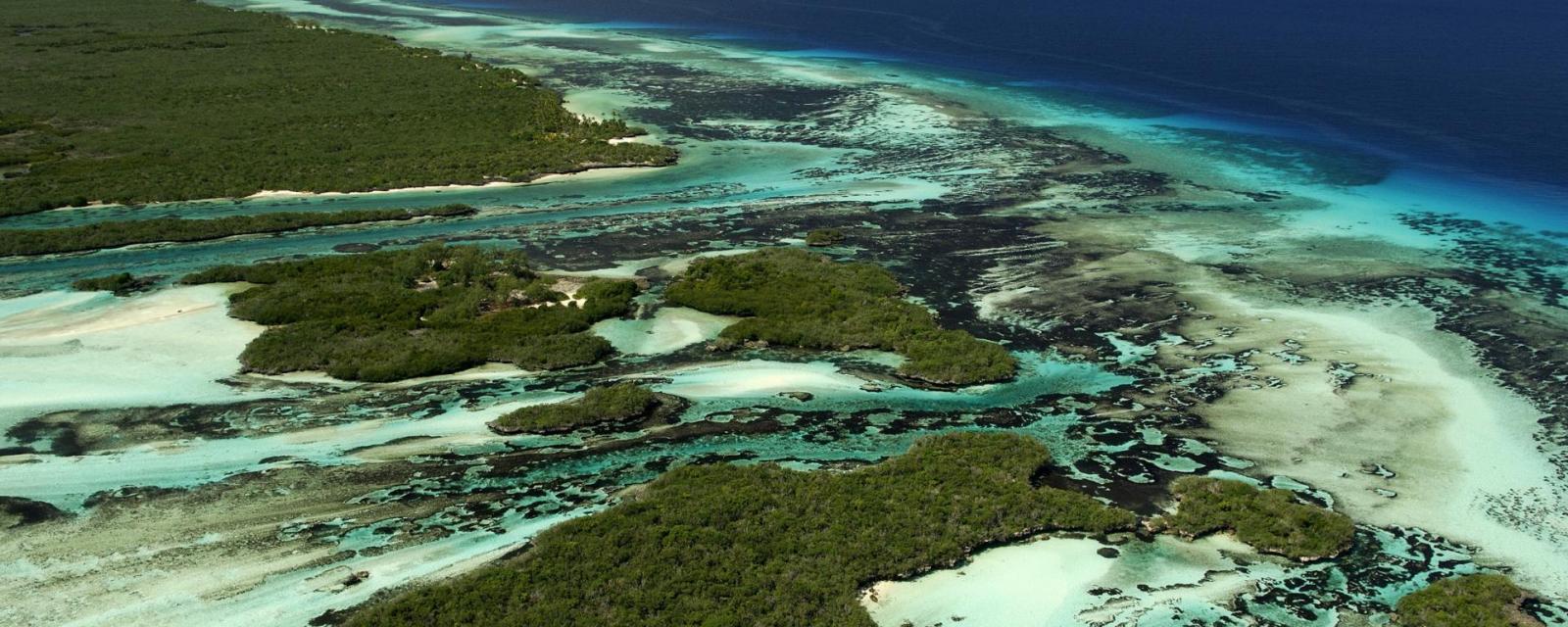
Flamingos are a relatively common sight in protected wetland areas in mainland Africa. With their characteristic features, including long legs, pink colouration and hooked bills, they surely are unmistakable and generally inspire a sense of awe. Records of flamingos on oceanic islands are, however, limited to two sites, these being far removed from each other. The one site is the Galapagos in the tropical waters of the Pacific Ocean and the other is Aldabra Atoll at similar latitudes in the western Indian Ocean. Flamingos on Aldabra reside in the remote area of Cinq Cases/Takamaka, which is in the southeast of Ile Grand Terre, where they often feed in brackish tidal basins.
Records of greater flamingos from the Aldabra Research Station date back to 1968 during the Royal Society administration of the Atoll and in that year groups of between 45 and 50 individuals were reported. Between then and 1995 the largest number that was seen in a group was 37 in 1974. In 1995 a major discovery was made that confirmed that flamingos have breeding status on Aldabra. Two adults were seen with a chick in the Takamaka area and three complete and three incomplete nests were observed.
Between 1995 and 2003 there are several records of sightings of flocks of up to 30 individuals. In 2003 43 individuals were reported, the largest group since 1968. A similar number were again reported in 2005, the same year that the remote pool where nests were previously reported in 1995 was rediscovered and six nests were found.
A census of flamingos on Aldabra was scheduled for November 2006. The idea was to visit as many as possible of the pools in the Cinq Cases/Takamaka region where flamingos have been reported in the past. An important objective was also to find the pool where flamingos have been reported to breed. Myself, three rangers, the island manager (Guy Esperon) and a volunteer set off early in the morning of the 21st of November for east Grand Terre. The crossing by boat through the lagoon from the research station takes about an hour and has to be planned according to the tides. To reach our destination we had to leave at 6:30 am so that there would be enough water to reach the landing stage at Cinq Cases. As “Bumboat” tore through the crystal and silent water the first rays of sun peaked over our destination. Four of us were dropped at the Takamaka landing stage and the other two proceeded to the Cinq Cases landing stage where the boat would be left.
A northern wheatear, an occasional vagrant to Aldabra, flicking its wings was the first surprise sighting at the old dilapidated Takamaka hut, which was last used in the Royal Society days. We saw no flamingos at Bassin Ibis or Bassin Mackenzie at Takamaka. Although the nesting locality previously mentioned is directly east from Bassin Mackenzie, with the help of Google Earth we knew that we had to proceed further south before turning east so as to avoid some very thick and impenetrable pemphis scrub. We managed to find the “nesting basin” and observed 11 flamingos, four of these being much smaller than the rest yet pinkish in colour. Juveniles are typically grey rather than pink in appearance and when very young have a decurved bill. They flew east when they saw us and we searched for nests around the vegetated perimeter of the bassin. We found 12 relatively fresh nests and 10 older nests, over three times the most that have previously been reported on the atoll. The nest are short cylindrical pillars of mud with a shallow concave nest cup.
With high spirits we continued further east towards the Cinq Cases landing stage, an area where flamingos are often seen. Not far off we came across a very shallow water-filled depression and were surprised by the sight of 49 flamingos. We carefully counted as they characteristically walked one direction then turned and walked back in the opposite direction. Once again they flew off, also in an easterly direction. About 40 minutes later, close to midday, we reached the upper reaches of the landing stage and after wading several times from one side to the other of the main tributary we came across another large group. Here we counted 56 individuals, the most that have been reported since 1892 when Abott reported a flock consisting of several hundred. It is possible and probably likely that the groups we saw earlier were incorporated into this group. Earlier in the morning the party that took the boat to the Cinq Cases landing stage saw 25-26 flamingos flying over the western reaches of the landing stage. It is uncertain if these were part of any of the groups we saw. Our count of 56 is, however, an absolute minimum and it is clear that to allow for an accurate count many people will be required and several areas will have to be covered at the same time. At least five of the flamingos seen in the group were juveniles and clearly grey in appearance. A larger number were much smaller than the rest yet pink in appearance. Some sexual dimorphism is evident in flamingos and this could possibly explain this observation as flamingos gain the pink colouration when they are adults and fully grown.
Whether flamingos on Aldabra form a resident population or if they are migrants from east Africa has been the subject of much speculation. Sightings of flamingos have been reported throughout the year which seems to indicate that there is at least a small resident population on Aldabra. This population could arguably be augmented by migrants. Similar uncertainty revolves around the frequency of nesting activity on Aldabra. The nesting site has rarely been located as a roundabout route has to be followed to avoid the dense scrub. A future priority of the Seychelles Islands Foundation staff manning the Aldabra Research Station will be to ensure regular monitoring of nests in this area.